
Evoked potentials track specific nerve pathways from point to point. But protecting the brain as a whole during surgery requires a continuous, global view of its electrical activity. Electroencephalography (EEG) provides exactly that — a real-time window into the health of the cerebral cortex throughout the course of a procedure.
Texas IOM incorporates intraoperative EEG monitoring as a core component of its neuromonitoring capabilities, with CNIM-credentialed technologists and real-time neurologist oversight on every case.
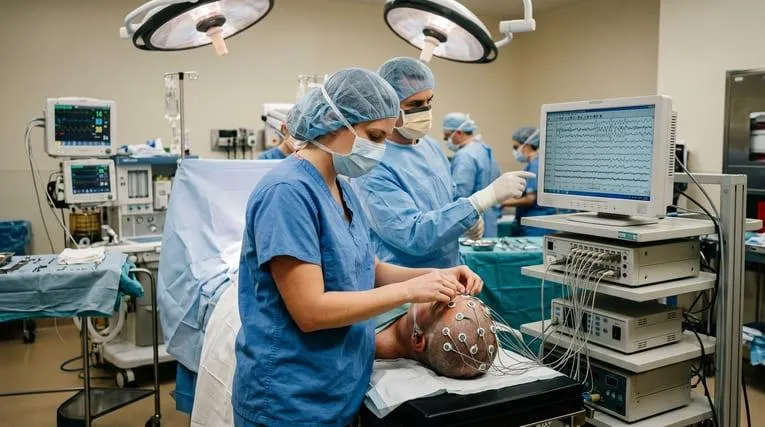
What EEG Measures
An EEG records the continuous, spontaneous electrical activity of the cerebral cortex. Specialized electrodes are placed across the patient's scalp in a strategic configuration that maps activity across brain regions. Unlike evoked potentials, which require an external stimulus to generate a response, EEG passively records the brain's ongoing electrical patterns — displayed as characteristic brainwaves — without any stimulation required.
Why EEG Matters in Surgery

Ischemia Detection During Vascular Procedures
Brain tissue is acutely sensitive to oxygen deprivation. During carotid endarterectomies, cerebral aneurysm clippings, and open-heart surgeries involving cardiopulmonary bypass, EEG serves as a primary early warning system. If blood flow to any region of the brain drops, the EEG waveforms in that area will immediately begin to slow or flatten. This gives the surgical team a critical window to restore perfusion before permanent stroke or tissue damage occurs.

Monitoring Anesthesia Depth and Burst Suppression
EEG allows the anesthesia and IONM teams to track precisely how deeply a patient is anesthetized throughout the procedure. In certain neurosurgeries, surgeons deliberately induce a state called burst suppression — a specific EEG pattern that lowers the brain's metabolic demand and protects it under stress. EEG is the only reliable tool for accurately achieving and maintaining this protective state in real time.

Detection of Intraoperative Seizures
Structural manipulation of the brain or the use of certain medications during surgery can trigger localized or generalized seizures. Because patients are fully anesthetized and pharmacologically paralyzed, no physical convulsions will occur — making these events completely undetectable without monitoring. EEG is the only modality that can identify these silent intraoperative seizures, enabling immediate medical intervention before the patient sustains injury.
EEG as Part of a Complete Monitoring Program
While sensory and motor evoked potentials monitor the specific wiring of the spinal cord and brainstem, EEG monitors the brain's primary power grid. Used together within a multi-modality IONM program, they provide comprehensive neurological coverage — protecting both targeted neural pathways and global cortical function throughout even the most complex surgical procedures.

GET STARTED
Ready to Schedule a Case or Learn More?
Our team is easy to reach. Whether you are scheduling your first case or want to learn more about what we do, we are happy to talk.
© Copyright 2026 | All Rights Reserved Texas IOM | Terms & Conditions | Privacy Policy